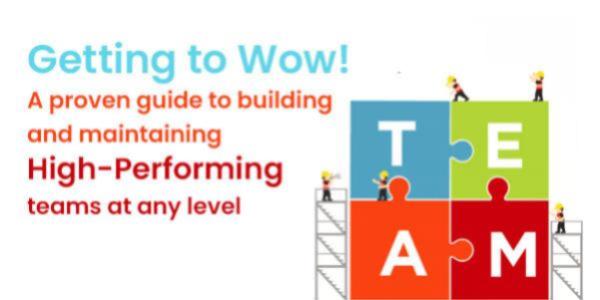
Getting to Wow! - A Proven Guide to Building and Maintaining High-Performing Teams at Any Level
About the Course:
The purpose of this session is to give you a model for understanding what goes into creating and maintaining a high-performing team. The Membership-Control-Goals (MCG) model describes the continuous dynamics that predict how and why teams progress over time and how and why teams run into trouble.
Whether it’s in your professional or personal life, you are often working as part of a team. Whenever two or more people come together to achieve a common goal, there is a team. When things go right, the people work well together, and teams achieve at a high level. When things go wrong, there is finger-pointing, conflict, and the team struggles. This session is all about learning what goes into building a strong, united, and successful team. We will explore the developmental cycle that teams experience when they are doing their work.
One way to look at understanding and improving work performance is by looking at aspects of work from the perspective of teams. What kinds of communications we use, how effectively we solve problems, how efficiently we implement solutions, and how we feel about the work we do and about the work of others are all things that take place in the context of defined groups. For our purposes here, any group of people working together to accomplish a common goal can be viewed as a team.
Course Objectives:
At the end of this session, participants will:
- Understand what we mean by a high-performing team.
- Be able to use the analogy of sports teams to analyse the dynamics of their teams.
- Recognize the three factors at work in a team’s developmental cycle.
- Be able to identify what conditions must be present in order for a team to succeed.
- How to diagnose team health and address problems.
Who is the Target Audience:
- Current and future leaders of teams
Basic Knowledge:
- Experience being on a team is helpful